A Wide-Notch Comb Filter
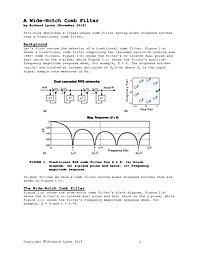
This article describes a linear-phase comb filter having wider stopband notches than a traditional comb filter.

Summary
This article presents a linear-phase comb filter architecture that produces substantially wider stopband notches than a traditional comb filter. Readers will learn the design rationale, frequency-domain behavior, and practical tradeoffs for applying wide-notch comb filters in DSP systems.

Key Takeaways
- Design a linear-phase wide-notch comb filter and derive the coefficient relationships that control notch width.
- Analyze the filter's frequency response and measure notch width and depth using FFT-based spectral analysis.
- Compare wide-notch performance and complexity versus traditional comb filters to choose the right approach for the application.
- Implement the filter efficiently and understand practical issues such as phase linearity, numerical precision, and implementation tradeoffs.
Who Should Read This
Intermediate DSP engineers and signal-processing practitioners working on audio, communications, or radar who need robust periodic-interference suppression with controlled notch width.
TimelessIntermediate
Related Documents
- A New Approach to Linear Filtering and Prediction Problems TimelessAdvanced
- A Quadrature Signals Tutorial: Complex, But Not Complicated TimelessIntermediate
- An Introduction To Compressive Sampling TimelessIntermediate
- Lecture Notes on Elliptic Filter Design TimelessAdvanced
- Computing FFT Twiddle Factors TimelessAdvanced
















