The Swiss Army Knife of Digital Networks
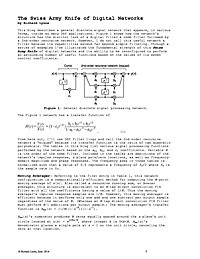
This article describes a general discrete-signal network that appears, in various forms, inside so many DSP applications.

Summary
This article presents a compact, general discrete-signal network that appears in many DSP applications and shows how that single structure maps to common DSP building blocks. Readers will learn to identify the network's canonical forms and how to leverage them to simplify filter, FFT, communications, and radar system designs.
Key Takeaways
- Recognize the canonical discrete-signal network and map it to familiar FIR/IIR, cascade, and parallel implementations.
- Apply the network model to simplify multistage and FFT-based filter designs for reduced complexity and improved numerical behavior.
- Use the network as a unifying template to translate signal-chain requirements across communications, radar, and audio/speech systems.
- Adapt the structure to support adaptive-filter or reconfigurable implementations for runtime tuning and system identification.
Who Should Read This
Advanced DSP engineers, researchers, and graduate students who design filters, FFT-based systems, or communications/radar signal chains and want a unifying discrete-network model to simplify analysis and implementation.
TimelessAdvanced
Related Documents
- A New Approach to Linear Filtering and Prediction Problems TimelessAdvanced
- A Quadrature Signals Tutorial: Complex, But Not Complicated TimelessIntermediate
- An Introduction To Compressive Sampling TimelessIntermediate
- Lecture Notes on Elliptic Filter Design TimelessAdvanced
- Computing FFT Twiddle Factors TimelessAdvanced

















