An Efficient Linear Interpolation Scheme
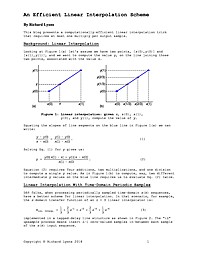
This article presents a computationally-efficient linear interpolation trick that requires at most one multiply per output sample.

Summary
Rick Lyons describes a compact, computationally efficient linear interpolation trick that requires at most one multiply per output sample. The article explains the algorithm, implementation notes (including fixed-point considerations), and where the method is most appropriate for real-time resampling and low-cost DSP applications.

Key Takeaways
- Implement the one-multiply-per-sample linear interpolation algorithm using the provided approach and pseudocode.
- Reduce CPU load for resampling and simple fractional-delay tasks by replacing naive interpolation with this efficient scheme.
- Evaluate interpolation error and understand trade-offs versus higher-order interpolators for your application.
- Optimize and integrate the method into real-time pipelines, including fixed-point and SIMD-friendly implementations.
Who Should Read This
Intermediate DSP engineers and embedded developers who implement resampling, up/down-sampling, or low-cost fractional-delay interpolation in audio, communications, or real-time systems.
TimelessIntermediate
Related Documents
- A New Approach to Linear Filtering and Prediction Problems TimelessAdvanced
- A Quadrature Signals Tutorial: Complex, But Not Complicated TimelessIntermediate
- An Introduction To Compressive Sampling TimelessIntermediate
- Lecture Notes on Elliptic Filter Design TimelessAdvanced
- Computing FFT Twiddle Factors TimelessAdvanced
















