DSPRelated.com
A Beginner's Guide To Cascaded Integrator-Comb (CIC) Filters

A Beginner's Guide To Cascaded Integrator-Comb (CIC) Filters

Rick Lyons
TimelessBeginner

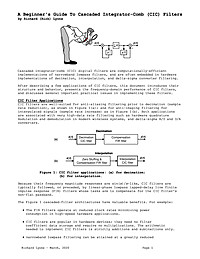
This article discusses the behavior, mathematics, and implementation of cascaded integrator-comb filters.



Summary

This article introduces the behavior, mathematical basis, and practical implementation of cascaded integrator-comb (CIC) filters. The reader will learn how CIC filters perform decimation and interpolation, their characteristic sinc-shaped frequency response (droop), and simple design and implementation techniques for software and hardware.

Key Takeaways

  • Understand the integrator-comb structure and derive the CIC filter transfer function.
  • Analyze CIC frequency response and quantify sinc droop and passband behavior for different stages and rates.
  • Design basic CIC decimators/interpolators and choose parameters (stages, rate change, differential delay) to meet specs.
  • Implement CIC filters in software and resource-constrained hardware (fixed-point and FPGA-friendly approaches) and apply compensation techniques to correct droop.

Who Should Read This

Engineers, DSP students, and embedded developers with basic DSP knowledge who need to design or implement efficient multirate decimators/interpolators in software or hardware.

TimelessBeginner

Topics

Filter DesignMultirate SystemsReal-Time DSP

Related Documents

Related Books

Shanthi Pavan
C. Britton Rorabaugh